
WHY INVEST

Blue Green Energy is developing an integrated network of hydrogen production facilities and commercial fueling travel centers along major U.S. freight corridors.
Our strategy is built around a fundamental opportunity: the transition to hydrogen-powered transportation requires infrastructure that does not yet exist at commercial scale.
WHY INVEST NOW?
Infrastructure must be developed before large-scale vehicle adoption becomes practical. Establishing strategic locations, production capacity, and fueling operations early could position BGE to participate in the market’s long-term growth.
INITIAL HYDROGEN PRODUCTION
8,000 kg/day
FIVE-FACILITY REVENUE MODEL
~$750M/year
Projected at stabilization
WHY INVEST
Blue Green Energy is building America’s first green hydrogen freight corridor, delivering the infrastructure heavy-duty transportation needs to reach Net Zero.
Why hydrogen now?
Automakers, ports, and fleets are already committing to hydrogen trucks. Infrastructure—not vehicles—is the bottleneck. BGE is building that infrastructure.
Projected Hydrogen Output
8,000 kg / day
Modeled Annual Revenue*
$76M – $190M
INVESTMENT THESIS
Blue Green Energy’s strategy combines a developing transportation market, a significant infrastructure shortage, and an integrated operating model designed to capture revenue as hydrogen adoption expands.
A Critical Gap in the Hydrogen Economy
Industrial hydrogen producers primarily serve established commercial customers. Vehicle manufacturers build trucks, and fleet operators transport goods.
But a long-distance hydrogen fueling network requires a dedicated infrastructure developer.
BGE is targeting the missing link between hydrogen production and transportation demand.
Multiple RevenueStreams. One Integrated Platform.
Each planned facility combines hydrogen production and retail fueling with commercial travel-center operations and DC fast charging.
Integrating these operations creates opportunities to generate revenue from several complementary businesses.
Designed for recurring revenue beyond hydrogen sales alone.
Build the FirstFacility. Replicate t he Model.
The Mojave project is intendedto establish the operatingfoundation for expansion intofive major freight corridors.
Our objective is to replicate an integrated infrastructure model at strategically positioned locations.
A five-facility development strategy with potential for broader national expansion.
CURRENT SHARE PRICE*
$2.50
Current offering price, subject tooffering documents.
INITIAL HYDROGEN CAPACITY
8,000 kg/day
Planned Mojave production capacity.
PLANNED PHASE I NETWORK
5 Facilities
Strategic Western U.S. freightcorridors.
Hydrogen solves what batteries can’t.
Class 8 trucks need long range, fast turnaround, and full payload capacity. Hydrogen fuel-cell systems provide 10–15 minute refueling, long-haul range, and lighter energy storage than multi-ton battery packs.
Only tech capable of decarbonizing long-haul freight at scale.
The vehicles are coming. Fuel isn’t.
Major OEMs are launching hydrogen trucks now, while the U.S. has almost no public hydrogen trucking infrastructure. BGE focuses on the bottleneck: production and fueling, not vehicle manufacturing.
First-mover advantage along critical freight corridors.
High-value, recurring revenue assets.
Each travel center combines hydrogen retail, EV fast charging, truck amenities, and powerful federal incentives for clean hydrogen production, creating diversified revenue at every site.
Engineered for multi-stream cash flow at each facility.
CURRENT SHARE PRICE*
$2.50
Early-stage pricing prior to full corridor build-out.
MODELED HYDROGEN REVENUE
$46M / yr
Based on 8,000 kg per day production at a single facility.
FEDERAL PRODUCTION CREDIT
$3.00 / kg
Inflation Reduction Act 45V tax credit for qualifying green hydrogen.
SOUTHWEST HYDROGEN CORRIDOR
Blue Green Energy’s development strategy begins with the Mojave Project, positioned along the I-15corridor connecting Southern California and Las Vegas.
From that initial location, our Phase I strategy calls for five facilities serving major Western U.S. freightroutes, establishing the foundation for a broader hydrogen transportation network.
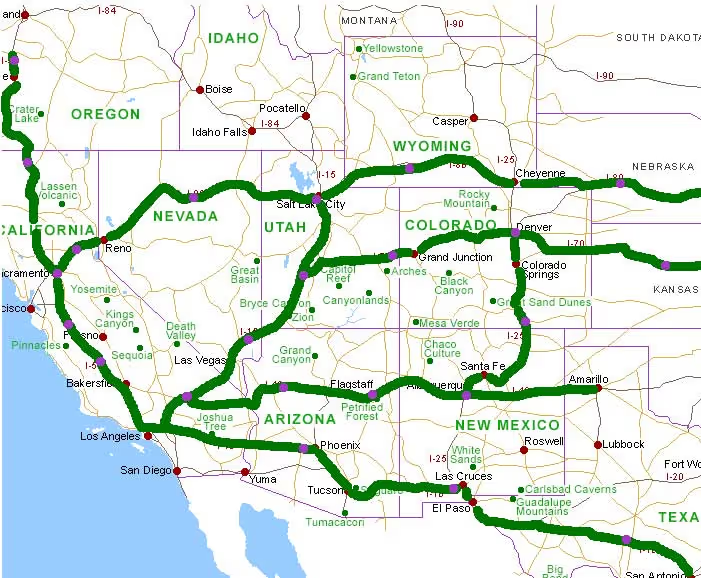
PLANNED NETWORK
Conceptual view of the Southwest hydrogen corridor connecting Southern California with Nevada, Arizona, Utah, Colorado, and Texas via high-capacity hydrogen travel centers.
SOUTHWEST HYDROGEN CORRIDOR
Blue Green Energy’s initial build-out focuses on the highest-value freight markets in the Western U.S., with hydrogen travel centers spaced every 250–300 miles to mirror today’s diesel truck stops.
PLANNED NETWORK
Conceptual view of the Southwest hydrogen corridor connecting Southern California with Nevada, Arizona, Utah, Colorado, and Texas via high-capacity hydrogen travel centers.
TIMING
Hydrogen transportation cannot scale without a dependable fueling network. Developing that networkrequires site control, permitting, engineering, financing, construction, and commercial relationships—wellbefore large-scale demand can be served.
Infrastructure Development Takes Time
Major hydrogen facilities cannot be built overnight. Developers must secure strategic locations, complete permitting and engineering, arrange financing, and construct complex facilities.
Companies that begin this process early may be better positioned as the market develops.
Strategic Corridor Positioning
Long-haul transportation depends on predictable fueling locations along established freight routes.
BGE’s strategy targets high-traffic interstate corridors where strategically located facilities could become important components of a future hydrogen fueling network.
A Scalable Operating Model
The Mojave project is intended to establish the production, fueling, and commercial operating model for future facilities.
Replicating a proven facility model could provide a more efficient foundation for network expansion, subject to financing and market demand.
Regulatory tailwinds
States are phasing out diesel and mandating zero-emission trucking, driving adoption of hydrogen fleets and the need for corridor-based fueling.
Federal incentives
The Inflation Reduction Act provides long-dated, production-based tax credits for green hydrogen, improving project-level economics and accelerating returns.
First-mover positioning
There is minimal hydrogen trucking infrastructure competition in the Southwest corridor today, leaving room for BGE to establish a defensible footprint.
Review our Executive Summary, Pitch Deck, Investment Overview, and Private Placement Memorandum to understand the business strategy, financial projections, offering terms, and investment risks.
* Financial projections are forward-looking estimates, not guarantees. Investment in an early-stage private company involvessubstantial risk, including potential loss of invested capital.
Review the full offering materials, financial projections, and risk factors before making any investment decision. Hydrogen infrastructure is a long-term build-out – and early participation can be meaningful.
*All figures are illustrative, forward-looking, and subject to change. Actual results may differ materially. Investing in private and early-stage companies involves risk, including loss of capital.


Disclaimer:The information presented is not an offer to sell or a solicitation of an offer to sell any securities mentioned herein. Offers are made only by prospectus or other offering materials. To obtain further information, you must complete our investor questionnaire and meet the suitability standards required by law.
The information and opinions contained in this document have been compiled or arrived at in good faith from sources believed to be reliable; however Blue Green Energy, Inc. cannot be held responsible for its accuracy or completeness.
Thank You,
Management